
Photo: Gerda Arendt · CC BY-SA 4.0
A camp that became a city
On 24 June 1478 Captain Juan Rejón founded the Real de Las Palmas, a military camp on the bank of the Guiniguada ravine; the island was annexed to the Crown of Castile in 1483. In 1492, on his way west, Columbus put in here to repair the rudder of one of his ships. The quarter that grew around that camp, with its cobbled streets and stately houses, was declared a Historic-Artistic Site in April 1973.
The square and the cathedral
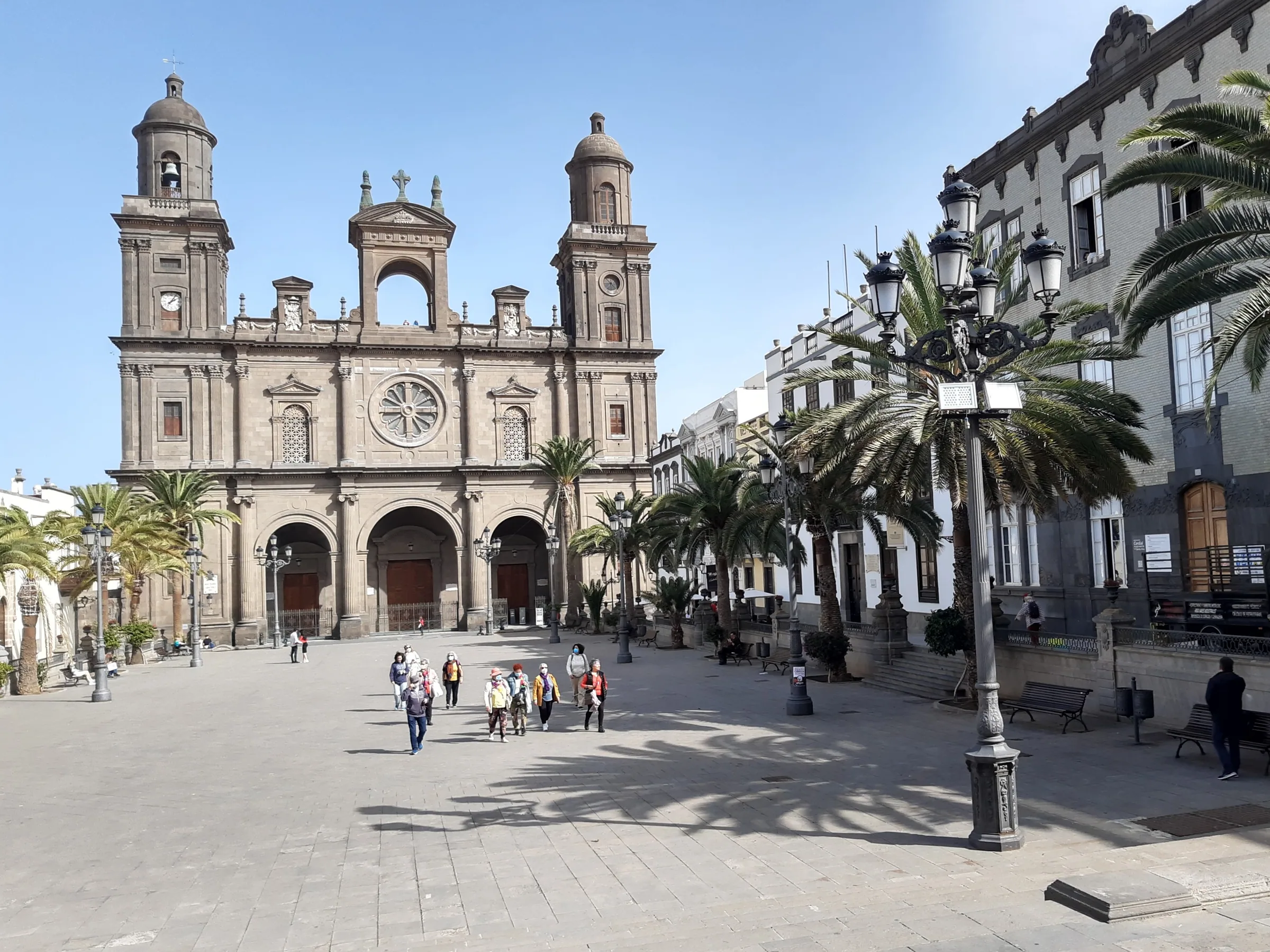
The Plaza de Santa Ana was laid out from the start as a civic and administrative space, a model later repeated by many cities in the Americas. It is guarded by eight cast-iron dogs, the "perros de Santa Ana", installed in the late nineteenth century, and framed by the Casas Consistoriales of 1856 (now a tourist office and art collection), the Bishop's Palace and the Provincial Historical Archive. The Cathedral of Santa Ana was begun in 1497 and took centuries to finish: Gothic inside, neoclassical on the façade. From its south tower you get one of the best views over the city.
Casa de Colón, museums and market
The Casa de Colón occupies the former Governors' House, on the exact spot of the founding; it has been a museum since 1954 and tells the story of the Canaries and their ties with the Americas, with a section on Columbus's voyages. A few steps away, El Museo Canario (1879) holds the richest collection on the ancient Canarians; the Ermita de San Antonio Abad, the city's first church, is where tradition places Columbus at prayer before sailing, and the CAAM shows contemporary art. The Mercado de Vegueta, from 1858, stands on the site of an open-air market held since 1787 and is the oldest produce market in the Canaries: island cheeses and wines, and churros for breakfast. The pedestrian streets between Mendizábal and La Pelota have filled with restaurants and terraces.
When to go
Vegueta can be walked in a morning. The market trades in the mornings from Monday to Saturday, and the cathedral, the Casa de Colón and the museums keep their own hours, so check before you go. As evening falls the quarter changes pace: terraces, tapas and life in the squares.
Tips
- Climb the south tower of the cathedral to take in the whole city at a glance.
- Have breakfast at the Mercado de Vegueta and ask about the island cheeses.
- Vegueta in the morning and Las Canteras in the afternoon: both fit in the same day.
- After dark, the pedestrian streets by the market are the place for tapas.