
Photo: Basotxerri · CC BY-SA 4.0
A volcano turned to stone
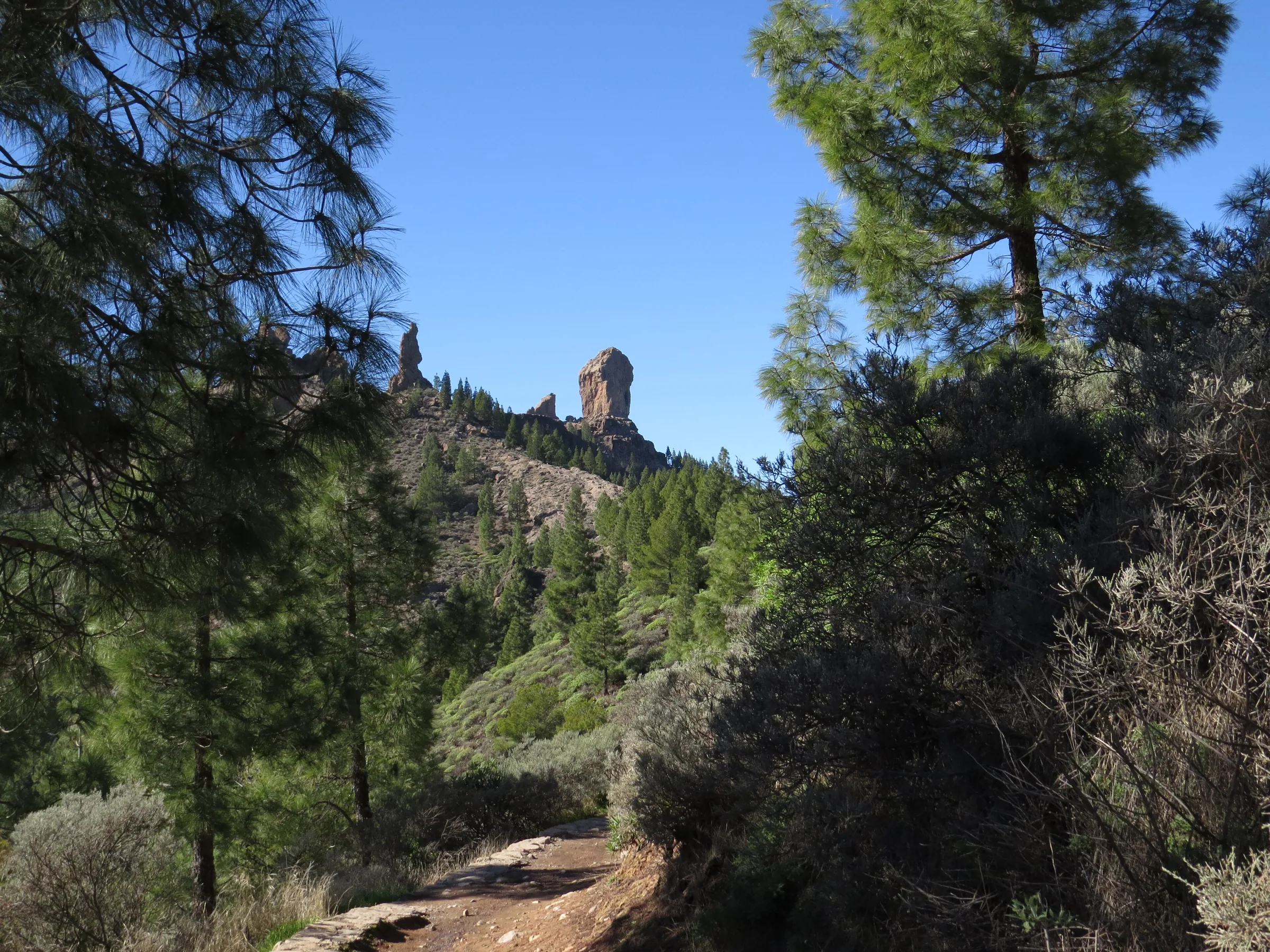
The rock is what survives of an explosive phase geologists call the Roque Nublo cycle, between 5.3 and 3.4 million years ago: clouds of burning ash that settled, cooled and welded into a breccia that bears its name. Erosion did the rest. It rises some 80 metres above its base and 1,813 above the sea, and since a German rope team reached the top in 1932 it has been a climbers' goal too. For Canarians it is above all a place of pilgrimage: the area was protected in 1987, it is a Natural Monument inside the Nublo Rural Park and it belongs to the Gran Canaria Biosphere Reserve, declared by UNESCO on 29 June 2005. These same summits have held, since 2019, the World Heritage cultural landscape of Risco Caído and the Sacred Mountains.
The path from La Goleta
The official trail (S-70) leaves from the Degollada de La Goleta pass on the GC-600, between Llanos de la Pez and Ayacata, and climbs steadily but kindly: roughly 1.5 kilometres to the foot of the rock, with stretches of stone steps. Canary pine gives way to an almost lunar landscape. On the left stands Roque del Fraile, shaped like a hooded monk; at the top lies the Tablón del Nublo, a stony plateau with the Caldera de Tejeda below, the white hamlets of Artenara and Acusa, the reservoirs, the ocean and, on clear days, Mount Teide. Beside the rock stands its squire, La Rana, the frog.
When to go up
The walk is open all year. In May, when the Pride takes place, the summit is usually far cooler than the coast and wind or cloud can roll in within minutes: pack a warm layer even if it is hot below. Early and late in the day are the quietest hours and the ones with the best light; between 10:00 and 17:00 access via La Goleta is regulated by reservation.
Booking, parking and shuttle
Since 2025 the Cabildo regulates access via the Degollada de La Goleta: between 10:00 and 17:00, every day, you need a free booking at reservasroquenublo.com, in slots of 60 people an hour. Bookings open for the current month and the next; after booking you get an email that must be confirmed within 3 days, and if you end up not going, cancel at least 24 hours ahead to avoid a penalty. Outside those hours, or if you walk up the La Culata or Degollada de la Hoya de la Vieja trails, no booking is needed. Parking at La Goleta is prohibited: leave the car at the park-and-ride sites in Tejeda or Cruz de los Llanos and take the shuttle, Global bus 18 (every 30 minutes, about 30 minutes from Tejeda and 10 from Cruz de los Llanos), or walk from Cruz de los Llanos along a trail of about 50 minutes. Bookings are suspended whenever a forest-fire alert is in force.
Tips
- If you will be walking between 10:00 and 17:00, book your free slot at reservasroquenublo.com well ahead: in high season the slots sell out. Carry the booking, with its QR code, and your ID or passport on your phone.
- Water, closed shoes and a warm layer: at 1,800 metres the sun is strong and the wind is cold. The emergency number is 112.
- Dogs may come along, always on a non-extendable lead.
- Round off the outing in the village of Tejeda, down in the valley, where bus 18 ends.